Lead generation for stem cell therapy is not the same game as lead generation for a med spa or a chiropractic office. You're selling a cash-pay, $15,000 to $30,000 decision, in one of the most compliance-sensitive corners of advertising, to a patient who is hopeful, skeptical, and doing their own research at midnight. Get the system right and every lead compounds. Get it wrong and you burn ad budget filling your calendar with tire-kickers who never had the belief or the budget to say yes.
This is the complete lead generation system we install in stem cell and regenerative medicine clinics. It's the same architecture behind a clinic we took from $36K to $479K per month in twelve months, at a 10x-plus return on ad spend. Read it start to finish, or jump to the stage where your pipeline is leaking.
What Lead Generation for Stem Cell Therapy Actually Means
Lead generation for stem cell therapy is the system that turns a stranger with knee pain into a qualified, educated patient sitting on a consultation ready to invest. It is not "getting more clicks." A lead is only valuable if it converts, and in high-ticket regenerative medicine the gap between a raw inquiry and a booked, show-up consultation is enormous. So the real job is not volume. It's generating qualified leads and moving them, deliberately, toward a yes.
That means a stem cell lead generation system has to do four things most clinics never build: attract the right patient compliantly, qualify them before they waste your team's time, educate them enough to believe, and follow up until they're ready. Miss any one and the other three leak out.
Why Stem Cell Lead Generation Is Different
Three realities make this niche unique, and each one shapes the system.
It's high-ticket and cash-pay. Nobody impulse-buys a $20K treatment. The decision is researched, emotional, and often involves a spouse. Your lead gen has to support a longer consideration window, not a same-day close.
It's compliance-heavy. Meta and Google aggressively police medical advertising. Outcome claims, before-and-afters, and "cure" language get ad accounts banned, and a banned account in this niche is brutal to recover. Both the medical and advertising sides are scrutinized — the FDA has publicly warned about unproven stem cell claims — so education-first creative isn't just safer, it's the only durable strategy. The clinics that scale embrace education-first creative, which both survives review and attracts better patients.
The patient arrives skeptical. They've read the horror stories, their doctor may have warned them off, and they're carrying real hope they're afraid to have crushed. Your system has to build belief and trust, not just capture a phone number.
Start With the Economics, Not the Ads
Before spending a dollar, know three numbers: your average treatment value, your consult close rate, and therefore what you can afford per booked consultation. A clinic collecting $15K per treatment at a 40% close rate can pay several hundred dollars per consult and grow profitably. A clinic that doesn't know its close rate is gambling, not marketing.
The Offer That Gets Stem Cell Patients to Raise Their Hand
Traffic without the right offer produces nothing. A stem cell patient will not hand over their number for "contact us today," because they're not ready to talk to a salesperson, they're trying to figure out if this is even real for them. The offers that convert meet them at that stage: a candidacy quiz ("Are you a candidate for stem cell therapy? Answer 6 questions"), a condition-specific guide ("What to know before treating knee arthritis with stem cells"), a transparent cost breakdown, or a genuinely low-pressure free consultation framed as an evaluation, not a sales call. Each of these doubles as a qualification tool: the quiz tells you who's a fit, the cost guide filters for budget, and the consultation framing pre-sells the experience. The rule is simple, offer the information they're already hunting for, and the opt-in follows. Selling the appointment before you've earned it is why most stem cell landing pages convert at 2% instead of 8%.
The Stem Cell Lead Generation System, Stage by Stage
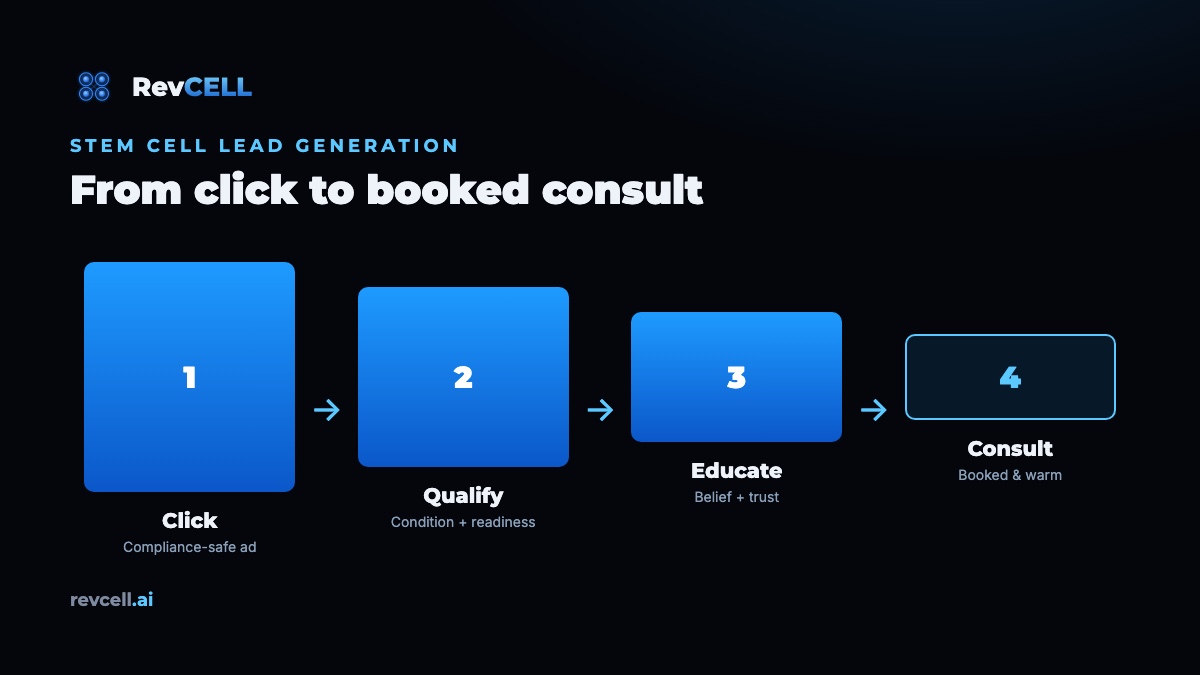
1. Compliance-safe paid acquisition
Paid ads are the fastest lever, and for stem cell therapy they split into two jobs. Google captures existing demand: the patient typing "stem cell therapy for knee pain cost" already wants the category, so search leads arrive with the belief door half open. Meta creates demand at scale and builds the retargeting pools where your cheapest patients live. Start with Google to validate your offer and consult process on warm intent, then layer Meta once your close rate is proven. The creative that works on both is educational, not promotional, which is exactly what keeps your account alive. See our playbooks for Google Ads and Facebook ads for stem cell clinics.
2. Condition-specific landing pages with a qualification funnel
Sending ad clicks to a generic "contact us" form is how clinics generate garbage leads. Every campaign should point to a condition-specific landing page (knee arthritis, back pain, shoulder) with a short qualification flow that asks about condition, duration, and treatment readiness before it offers a booking. Yes, you get fewer raw leads. But the ones who book are real, and your team stops burning hours on people who were never going to move. What separates a converting page from a trust-killer is covered in our stem cell landing page guide.
3. Speed-to-lead
This is the silent killer. Contact a new lead within five minutes and your connect rate is several times higher than contacting within an hour. A stem cell lead that sits overnight is a lead your competitor already called. If your front desk can't respond instantly during business hours, automate the first touch: an immediate text confirming the inquiry and offering booking times keeps the lead warm until a human takes over.
4. The education layer that turns leads into consults
A raw lead is not a patient. Between the first click and the consultation, every prospect needs three questions answered: does this work for my condition, is it safe, and why this clinic? Leave those to Google and you lose them to whoever answers deliberately. An automated education sequence, condition-specific evidence, honest process explainers, and real patient stories, arrives in the days after a lead comes in and quietly builds belief before the consult. This is the highest-leverage lead gen most clinics never build. The assets that do the work are covered in our guide to patient education materials that convert.
5. Retargeting the ones who didn't book
Most patients don't convert on the first visit, they convert on the second or third touch. Retargeting the visitors who didn't book costs a fraction of cold traffic and closes at a higher rate, because these people already know you. A clinic running acquisition without retargeting is paying full price for every patient and leaving the discounted ones on the table. The mechanics are in our medical retargeting strategy.
6. CRM and measurement
If your reporting stops at "cost per lead," you're optimizing the wrong number. The chain that matters is lead to consult to show to close to collected. A $30 lead that never books is worth less than a $150 lead that becomes a $20K patient. You need a CRM that tracks every lead through that pipeline so you can see exactly where it leaks, covered in our CRM guide for stem cell clinics.
Speed-to-Lead: The Silent Killer
The data on this is unambiguous: contact within five minutes and your connect rate is several times higher than contact within an hour. A lead that sits overnight is a lead your competitor already called. If your clinic can't respond fast during business hours, automate the first touch — an immediate text confirming the inquiry and offering booking times keeps the lead warm until a human follows up.
Retargeting: Where the Cheap Patients Live
Most patients don't book on the first visit — they book on the second or third touchpoint. Retargeting the visitors who didn't convert costs a fraction of cold traffic and closes at a higher rate, because these people already know you. A clinic running acquisition without retargeting is paying full price for every patient and leaving the discounted ones on the table. We covered the mechanics in our retargeting strategy guide.
Organic Lead Generation: The Compounding Layer
Everything above works the month you build it. Organic lead generation works forever. A single article answering "how much does stem cell therapy cost for knee arthritis" produces leads for years after it's written, and organic patients arrive pre-educated, which your consult process feels immediately. It's slow to start, six to twelve months for real traction, so fund it from paid profits rather than instead of paid. The clinics that win run both, with ads carrying the present while content compounds into the future. This entire lead gen system is one chapter of our complete regenerative medicine marketing guide, and the broader approach is detailed in our guide to regenerative medicine lead generation that converts.
Referral and Professional Lead Sources
The highest-trust leads you'll ever get don't come from ads at all. Chiropractors, physical therapists, orthopedic practices, and med spas see your ideal patients daily and often have nothing to offer them past their own scope. A structured referral program, clear criteria, an easy handoff, and a closed communication loop, produces patients who arrive pre-sold by someone they already trust. It's slower to build and relationship-driven, but nearly free per patient once it's running.
The Metrics That Actually Matter
Judge your stem cell lead generation on revenue, not vanity. Track cost per lead, but decide by cost per closed patient. With a $15K-plus treatment value, you can profitably pay several hundred dollars per booked consultation and still see a 10x return. The clinics that scale review five ratios weekly, by source: lead-to-consult, show rate, close rate, cost per consult, and blended cost per patient. That's how you know which channel to pour more into and which to cut.
The Most Common Lead Generation Mistakes
The biggest one is scaling ad spend into a broken consult process. Doubling lead volume into a 20% close rate just doubles the waste. Fix conversion first, then pour fuel on acquisition. The second is chasing the cheapest leads, which are almost always the least qualified. And the third is treating a lead as dead after two follow-ups, when most stem cell patients say "not yet," not "no," and belong in a monthly nurture track that turns one acquisition dollar into revenue months later.
Frequently Asked Questions
How much does lead generation for stem cell therapy cost?
Most clinics we work with start around $4,000 to $6,000 per month in paid media and scale past $10,000 only once cost-per-consult and close rate prove out. At a $15K-plus treatment value, a closed patient acquired for $600 to $1,000 is a strong return. Spend should follow evidence, not ambition.
What's the best channel for stem cell therapy leads?
Google Ads first, because search captures patients already looking for the treatment, which validates your offer on the warmest traffic. Add Meta for volume and retargeting once your consultation process reliably closes. Organic and referral become your cheapest channels over time.
Why are my stem cell leads unqualified?
Almost always because there's no qualification step between the ad and the booking. Add a condition-specific landing page with a short pre-qualification form, and you trade a flood of junk inquiries for fewer, real, ready-to-consult leads.
How fast should I follow up with a new lead?
Within five minutes during business hours. Connect rates fall off a cliff after the first half hour. If a human can't respond that fast, automate an instant text so the lead stays warm until your team calls.
How long until lead generation produces patients?
Paid channels produce booked consultations within days and reliable cost-per-consult data within 60 to 90 days. Organic lead generation takes six to twelve months to compound but becomes your cheapest source. Anyone promising profitable scale in week two is selling you a spike, not a system.
Want this lead generation system installed in your clinic instead of assembled piece by piece? Book a free 30-minute strategy call and we'll map it to your market and your numbers.