Most regenerative medicine case studies are vague. They show a screenshot of an ad account, claim "more leads," and skip the part that matters: revenue. This one is different. It has names, numbers, and a timeline — because we ran it.
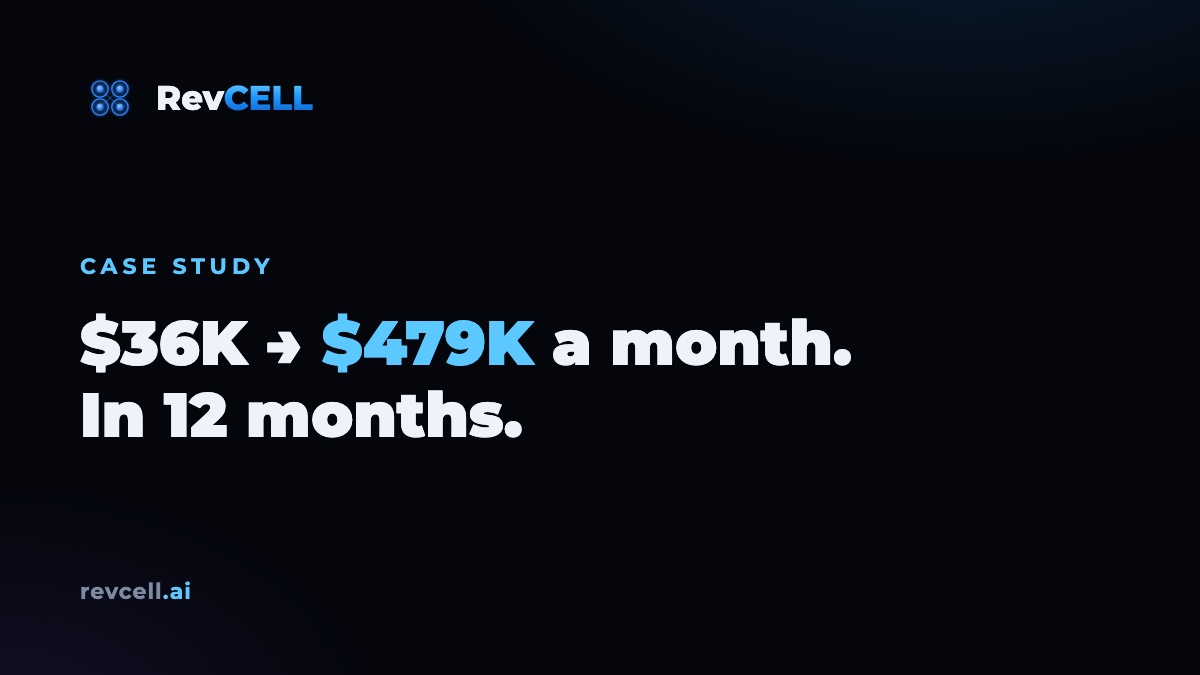
In 12 months, Odin Stem Cells, a nationwide US regenerative medicine clinic, went from $36,000 per month to a peak of $479,000 per month. Total new revenue generated: $3.1 million, at over 10x return on ad spend. You can read the full Odin Stem Cells case study here — this article breaks down the mechanics stage by stage, so you can judge exactly what applies to your clinic.
Where the Clinic Started
Odin had what most established clinics have: real clinical outcomes, experienced providers, and a website. Revenue came from referrals and organic search — which is another way of saying revenue was unpredictable and capped.
- No paid acquisition. Zero dollars on Meta or Google while competitors captured every high-intent search in the market.
- Cold consultations. Prospects arrived at sales calls uneducated and skeptical, so the team spent every call fighting objections instead of closing.
- Static PDF proposals. Treatment plans went out as email attachments — untracked, unopened, and easy to ignore.
- No follow-up system. Leads that didn't book immediately were gone forever.
The diagnosis was simple: this was not a marketing problem. It was a missing system. A clinic delivering $15,000–$30,000 treatments cannot run on the infrastructure of a clinic selling $150 visits — but that is exactly what most regenerative medicine practices try to do.
The 4-Stage System We Installed
Stage 1: Attract — paid acquisition built for compliance
We built Meta and Google Ads campaigns targeting the patients who actually buy regenerative treatments: chronic pain sufferers, arthritis patients, and surgery-averse prospects researching alternatives to joint replacement.
Regenerative medicine advertising has a constraint most agencies learn the hard way: platforms reject medical claims aggressively, and repeat violations kill ad accounts permanently. The campaigns that survive — and scale — are educational. Ours led with education and sold second, which kept accounts healthy while competitors burned through banned accounts and started over from zero trust.
On Google, we captured high-intent searches like "stem cell therapy for knee pain" — the 11PM searches from people in real pain, actively looking for a solution. On Meta, we interrupted the right audiences with educational content that earned the click instead of demanding it. Custom landing pages built specifically for regenerative medicine — not generic healthcare templates — converted that traffic into qualified leads with multi-step forms that filtered out tire-kickers before they ever reached the sales team.
Stage 2: Educate — pre-sell before the call
Cold traffic does not buy $20,000 treatments off one landing page visit. Between the click and the consultation, we inserted an education layer: explainer content, treatment process graphics, webinars, and automated email and SMS sequences that answered the questions every prospect has — Does this work? Is it safe? Why is it better than surgery? What does it cost?
This stage is the one most clinics skip, and it is why their sales calls feel like interrogations. When a prospect has already seen how the treatment works, read patient outcomes, and understood why surgery-averse patients choose regenerative medicine, the consultation stops being a debate and starts being a planning session. Leads arrived pre-sold instead of skeptical.
Stage 3: Convert — kill the PDF, coach the close
We replaced static PDF proposals with interactive proposal pages — personalized, trackable web pages with treatment plans, pricing, financing options, and one-click payment. Proposals that used to take 30 minutes to assemble took 30 seconds. The sales team could see when a prospect opened their proposal, what they looked at, and when to follow up.
Alongside the proposal system, we trained the team on consultation structure and objection handling — scripts and frameworks for the objections every stem cell clinic hears: "Is it FDA approved?" "What if it doesn't work?" "That's expensive." Combined, close rates moved from the industry-standard 20–30% into the 40–60% range. Same leads, same treatments — different conversion infrastructure.
Stage 4: Scale — pour fuel on what's proven
With cost-per-patient known and every step of the funnel measurable, scaling stopped being a gamble. Ad spend grew from roughly $4K per month toward $10K+ as returns held, retargeting audiences compounded — most patients book on the second or third touchpoint, not the first — and strategic referral partnerships with orthopedic surgeons, chiropractors, and physical therapists added a second pipeline on top of paid.
The 12-Month Revenue Timeline
Revenue did not jump — it compounded. That distinction matters, because a system produces a curve, while a lucky month produces a spike that disappears.
- Months 1–3: Infrastructure phase. Campaigns launched, landing pages tested, tracking installed. Revenue moved from $36K toward six figures as the first paid patients closed.
- Months 4–6: Optimization phase. Cost-per-lead dropped as creative testing matured; the proposal system replaced PDFs and close rates climbed. Monthly revenue crossed $150K–$250K.
- Months 7–9: Scaling phase. Proven campaigns got more budget; retargeting audiences reached critical mass. Revenue passed $300K per month.
- Months 10–12: Compounding phase. Paid, retargeting, and referral partnerships stacked. Peak month: $479K.
The Numbers That Matter
- $3.1M in new revenue across 12 months
- $36K → $479K peak monthly revenue — a 13x multiple
- 10x+ return on ad spend, sustained while scaling
- 40–60% consultation close rate after the proposal system replaced PDFs, against an industry average of 20–30%
And because one case study can always be dismissed as luck: the same system produced $560K in five months for a Latin American clinic entering paid acquisition for the first time. Different market, different language, same mechanics.
How to Evaluate Any Regenerative Medicine Case Study
If you're researching partners for your clinic, hold every case study you read — including this one — to the same standard:
- Does it show revenue, not vanity metrics? Leads, impressions, and "engagement" don't pay for anything. Ask for monthly revenue figures and the timeline.
- Does it cover the full funnel? An agency that only shows ad results is handing your sales team a cold-lead problem. Acquisition, education, and conversion have to appear in the same story.
- Is it compliance-aware? If the case study never mentions how the ads survived platform review in a medical-claims category, the account probably didn't survive long either.
- Can they name the operators? Systems built by people who still run them beat theories sold by consultants. Ask who manages the accounts today.
What This Means for Your Clinic
The uncomfortable takeaway from this regenerative medicine case study: none of the four stages is optional. Clinics that run ads without an education layer buy cold leads that die in consultation. Clinics with great consultation skills but no acquisition system wait on referrals. The stages compound — or they don't work at all.
If your clinic delivers real outcomes but revenue still depends on referrals, you are leaving your market to whoever installs this system first. We run it as a high-touch partnership, limited to three clinic partners at a time, because deep implementation is what produced these numbers — not account management.
Frequently Asked Questions
How long does it take to see results?
Odin's first paid patients closed inside the first 90 days, but the compounding effect — where retargeting, education, and referral pipelines stack — showed up in months 4–6. Any partner promising overnight results in a high-ticket, compliance-heavy category is selling you a spike, not a system.
Does this work for clinics just adding stem cell treatments?
Yes — arguably better, because there's no legacy process to unlearn. The Latin American clinic in our second case study went from zero paid acquisition to $560K in five months. The system installs the same way whether you're established or entering the market.
What did ad spend look like?
Odin started around $4K per month and scaled past $10K as returns proved out. The point is not the budget — it's that spend only increased when cost-per-patient and close rates justified it.
Book a free 30-minute strategy call. We'll review your clinic, walk through the 4-stage system, and build your custom $500K+ roadmap.