When a clinic owner searches for a regenerative medicine marketing agency, they are usually not looking for another list of channels. They already know they can run ads, publish articles, and post on Instagram — the channels are not the hard part. They are trying to find out what a specialist should actually do once they are hired — and why so many firms that "do healthcare" stall in this category.
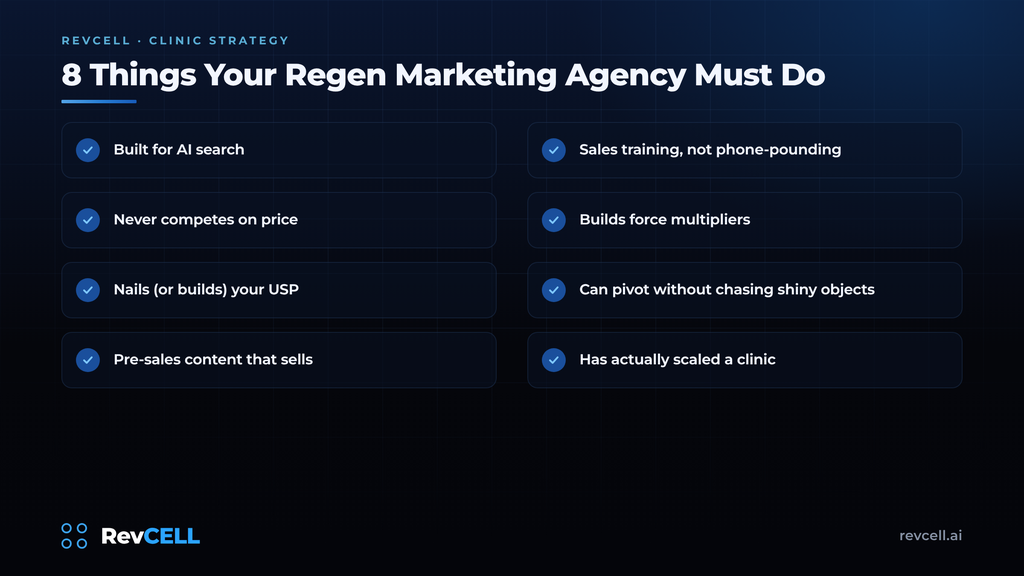
A regenerative medicine marketing agency should do more than buy traffic. It should build the clinic for how patients actually choose a five-figure, cash-pay treatment today: visible on Google and in AI answers, positioned on something other than a discount, supported by education and sales training that help a small team close, equipped with force multipliers that give that team time back, and led by people who have already scaled a clinic like yours.
If you are still deciding whether to hire, start with in-house vs agency clinic marketing, which covers how to evaluate a firm and the red flags to walk away from. For the first quarter after you hire, see what a stem cell therapy marketing agency should do in 90 days. For the category page covering what RevCELL runs as a stem cell therapy marketing agency, start there. The regenerative medicine marketing guide and our ranking of the best regenerative medicine marketing channels cover the tactics. This article is about the work underneath those tactics.
A generalist playbook fails here for three reasons. FDA and FTC rules, plus Google and Meta ad policies, leave no room for outcome promises. The purchase is cash-pay and expensive, so patients research for weeks before they book. And most of the revenue is decided after the click, in the education, the follow-up, and the consult. An agency that only reports cost per lead is optimizing the cheap end of the funnel. The number that matters is what it costs to acquire a paying patient.
Build the clinic for a world where patients ask AI first
Patients researching stem cell therapy no longer start and finish on Google. A growing share ask ChatGPT, Perplexity, or whatever AI tool they already trust. If those tools cannot describe your clinic clearly — what you treat, where you are, and why someone would choose you — you are invisible to people who will never type your name into a search bar.
That is not a reason to abandon SEO for stem cell clinics. It is a reason to stop treating SEO and AI search as separate projects. The same work serves both: pages that state plainly what you offer, structured data a machine can parse, and third-party sources that say the same things your site does. The mechanics are in AI search visibility for stem cell clinics. You need an agency that lives and breathes this shift, or the clinic will be built for a discovery world that is already shrinking.
Do not compete on price
If an agency's main move is running ads on discounts, it is the shortest path to commoditizing your clinic.
Price competition in this category is a race to the bottom. Once patients learn to shop stem cell therapy like a coupon, you are no longer selling expertise or a specific approach. You are selling a cheaper version of the same thing, and there will always be a clinic willing to go lower. People who chose you because of a promotion are also the first to hesitate, renegotiate, or leave a review about the price rather than the care.
Cash-pay pricing has to be framed, not hidden and then discounted. A serious agency helps you talk about price against the real alternatives — surgery and recovery, years of injections, or the cost of doing nothing — without training the market to wait for a sale. Cash-pay treatment marketing covers how to have that conversation. Promotions have a place, carefully and rarely. They should not be the strategy. If the only way the ads work is to cut the price, the offer is not positioned yet.
Nail the USP, or help manufacture it
"Great, you offer stem cells? So do 5,000+ other clinics a patient could choose from, between the U.S. and the ones a short flight away. What makes yours special?"
U.S. patients alone can already pick from roughly 2,500 to 3,000 clinics in this country, and they can also fly anywhere in the world. Against that set of options, 5,000+ is conservative. If you cannot answer what makes yours special in a sentence a patient would repeat, you will lose those patients to the clinic that can. Equipment, "advanced protocols," and "personalized care" are not a unique selling proposition. Every competitor within driving distance says the same thing.
A regenerative medicine marketing agency has to know how to find that position, or how to manufacture it from what is already true of the practice. That might be a condition you treat unusually well, a process patients can verify, a physician background that matters to a specific buyer, or a patient experience no one else in the market is willing to operationalize. It will not be a slogan invented in a kickoff meeting.
This is what allows you to hold price and give your sales team something to say besides "we also do stem cells." How to differentiate a stem cell clinic covers how to locate that position. The agency's job is to turn it into the offer, the ads, the site, and the consult conversation, and keep saying it until patients can say it back. If the firm cannot help you answer that question, it will default to discounts and generic creative.
Pre-sales content and sales training that actually sell
Lance and I would rather have two or three excellent sales reps who know the offer than a team of ten pounding the phones and scaring people away. Patients arrive cautious, often after weeks of research, and they can feel the difference between a rep who understands the treatment and one who is working a script. A smaller, well-trained team booked with the right conversations will outperform a larger team chasing unqualified leads.
That only works if marketing does the pre-sales work. Creative agencies can film and edit whatever you want. Great marketers film and edit what sells, because they understand what gets a cash-pay buyer ready to book: clear education, honest talk about candidacy, proof that can be checked, and a next step that does not require a leap of faith. That content should answer doubts before the consult, not decorate the brand. Our patient education funnel guide covers how that sequence should run.
The same principle applies to sales training. An agency that disappears after the lead form is asking your team to close a five-figure, compliance-sensitive decision with whatever they already know. A partner that owns the sales process helps reps explain the offer without making promises they cannot make, then stay with the long "let me think about it" cycle.
Marketing that keeps good salespeople
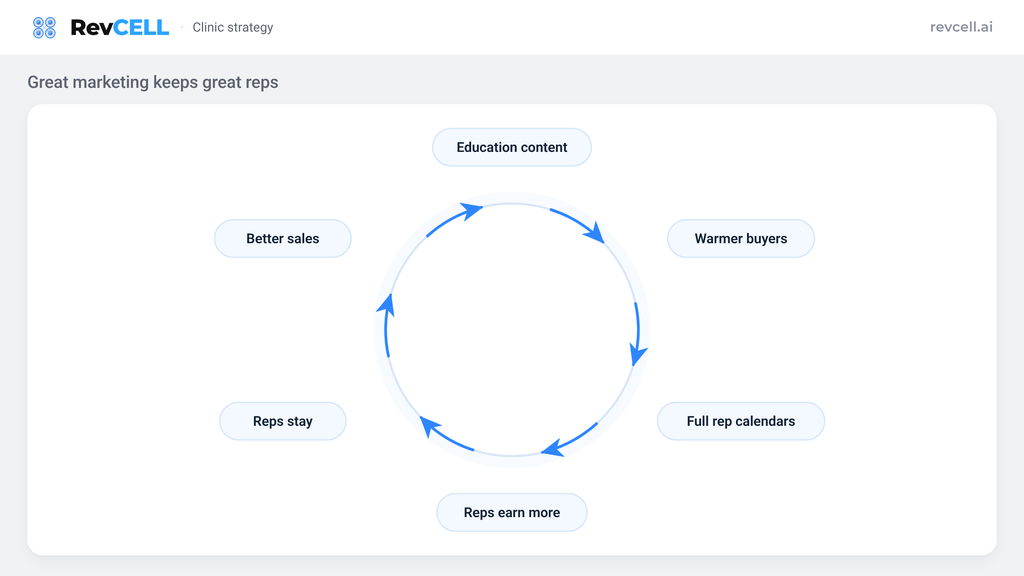
To attract and keep good talent, you need great training and great marketing. Those two things are connected.
Marketing that educates buyers before they sit down softens the load on the reps. The consult becomes a conversation with someone who already understands the basics and is closer to a decision. It also keeps calendars full of qualified, interested leads. Reps who consistently talk to people they can actually help make more money and stay longer. Reps who spend their days on tire-kickers, no-shows, and price shoppers burn out or leave. That is the sales-rep merry-go-round, and it is expensive: you lose the person and the relationships they were building, then start training from scratch.
A regenerative medicine marketing agency should care about that loop, not just the cost per lead. The sales team staffing guide goes deeper on roles and hiring. The agency's part is to make the job doable: enough of the right conversations, enough education in front of them, and a process that helps a tight team win.
Build force multipliers
Paid ads can fill a calendar. They cannot, on their own, give a small team its time back — or protect the clinic if those ads stop.
A regenerative medicine marketing agency should build force multipliers: systems and assets that do work the team would otherwise repeat by hand, and demand the clinic does not have to buy every day. Follow-up texts and emails, PDF proposals, and invoices all have to happen, and hours disappear if someone rebuilds them for every lead. We automate those repeat tasks so two or three strong reps stay in conversations instead of in documents.
The same idea applies to sales assets. The pre-sales content described earlier does more than warm up a buyer. When it is doing its job, it answers the questions the team used to answer on every call, and it gives those reps time for people who are actually close to a decision. Creative that pre-sells is a force multiplier. A folder of one-off videos is not.
The third multiplier is baseline demand that does not depend on an ad account. SEO for stem cell clinics and organic social, done consistently, raise the floor of free traffic to the site. That work is slower than media buying, which is why generalist firms often skip it. It is also what keeps inquiries coming in if ads get shut off in an emergency — a policy change, a rejected account, a sudden pause in spend. A clinic that only exists in the ad platforms is one disruption away from a quiet calendar.
We do not treat these as side projects. They are part of the same system as the ads and the sales process: less manual work, more pre-sold conversations, and a floor of inbound demand the clinic still has if paid traffic goes away.
An agency that can pivot
The world is changing, and an agency without a pulse on what is coming will be late. That is not an argument for shiny-object syndrome. Chasing every new platform or acronym is how budgets get scattered and nothing is given enough time to work. Pivoting means recognizing when a real shift has arrived — in how patients discover clinics, in what ad platforms will approve, or in a tool that actually shortens the path from inquiry to consult — and moving while there is still an advantage in moving.
AI search is a current example. Clinics that waited for a perfect case study missed a window in which the field was still thin. Platform claim enforcement is another: the line moves without a press release, and firms that live in these accounts notice it in days, not in a quarterly review. A good partner will also tell you when not to pivot. If last month's channel is still producing consultations under your cost target, the right move may be to go deeper, not to start over.
Someone who has actually scaled a clinic
There are a million marketing agencies. The question is whether the one you are considering has actually scaled a stem cell or regenerative medicine clinic.
"We can take on stem cell clinics" is not the same thing as "this is all we do." A generalist can read the policy page and promise to figure it out. A specialist has already made the expensive mistakes elsewhere: which claims get ads rejected, how long the consult-to-close cycle really runs, and where revenue leaks once the leads arrive.
At RevCELL, that is the entire company. We are not a healthcare agency that also works with regenerative clinics. We built RevCELL as a revenue acceleration system for stem cell and regenerative medicine clinics — marketing infrastructure plus sales optimization — and we do not take on other categories.
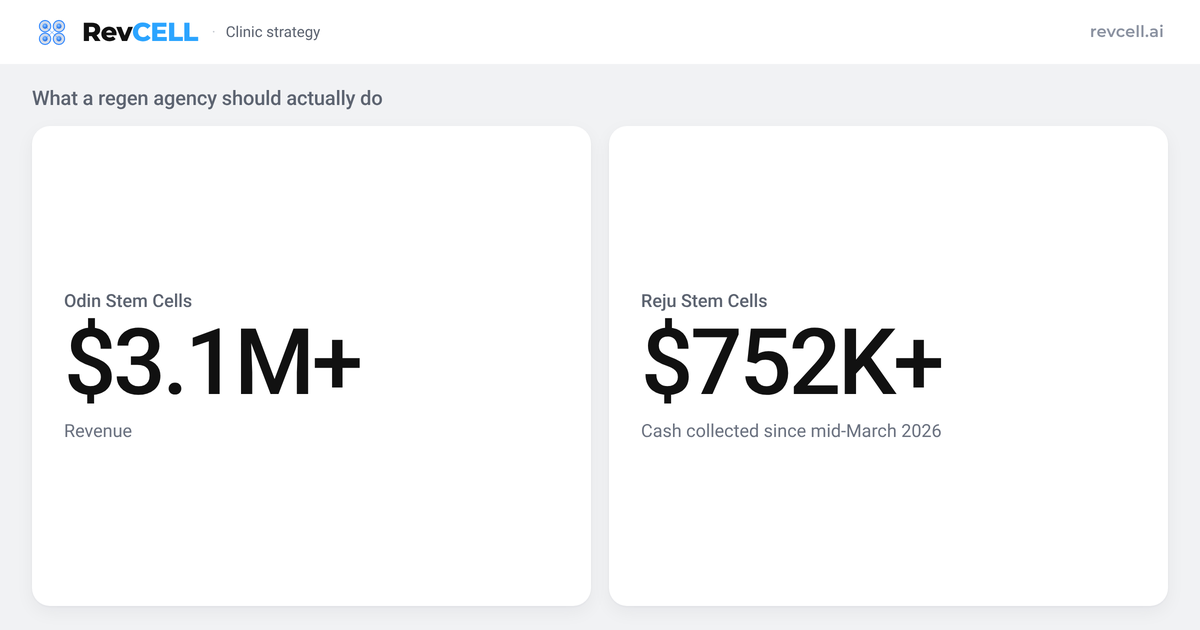
The proof should be specific. At Odin Stem Cells, RevCELL built a profit machine: deals averaging about $22,000, over $3.1 million in 2025 revenue on about $230,000 of actual ad spend, a return of roughly 13.5 times the ad dollars. Profit margin ran between 35% and 50% depending on the month, after the cost of cells and exosomes, marketing, commissions, and team payouts. Income per ad dollar is not profit. It is the starting point, and the margin is what was left after everything else was paid.
At Reju Stem Cells, the sales team has collected $752K+ in cash since we started pushing in mid-March 2026.
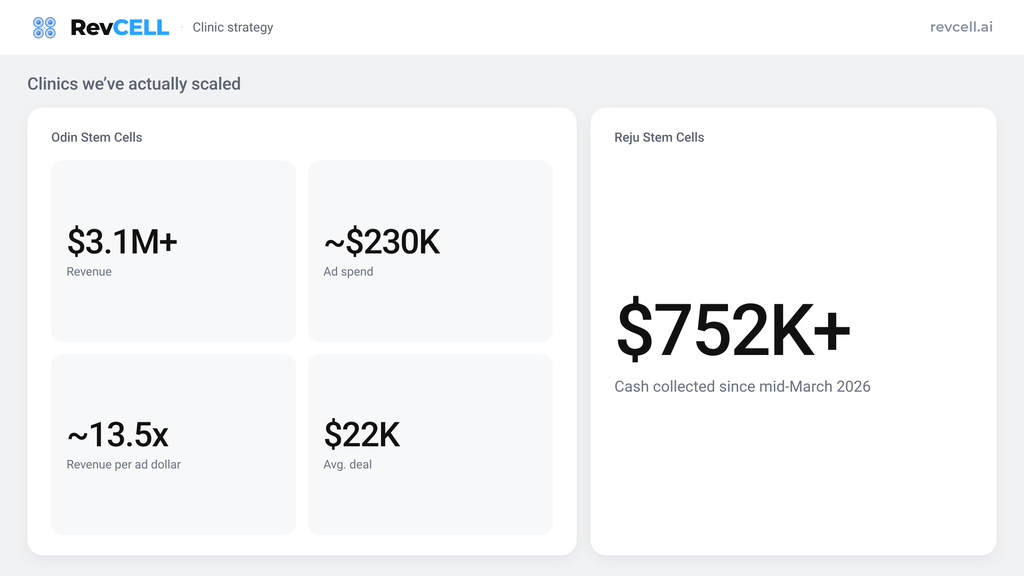
Those results came from the whole system, not from ads alone: paid acquisition, education, CRM, proposals, and sales training, built for this category's compliance rules and buying cycle. If an agency cannot show work like that, you are funding their education.
Generalist healthcare agency vs. a regenerative medicine specialist
The difference is what the firm treats as the job. For the named firms rather than the categories, see stem cell marketing agencies compared.
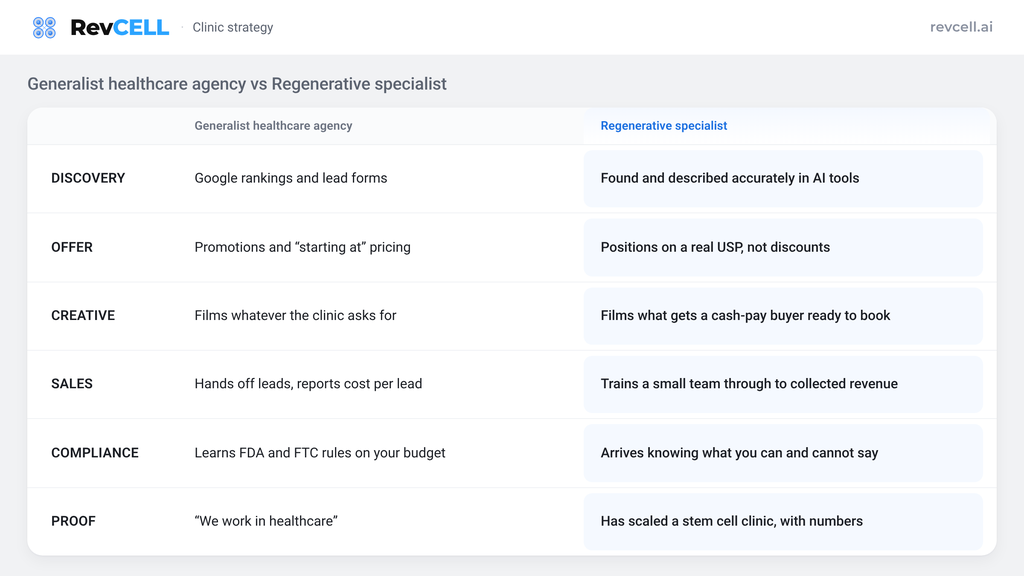
| Generalist healthcare agency | Regenerative medicine specialist | |
|---|---|---|
| Discovery | Optimizes for Google rankings and lead forms | Also builds the clinic to be found and described accurately in ChatGPT and other AI tools |
| Offer | Leans on promotions and "starting at" pricing | Positions the clinic on a real USP so you are not forced to discount |
| Creative | Films and writes whatever the clinic asks for | Films and writes what gets a cash-pay buyer ready to book, within claim rules |
| Sales | Hands off leads and reports cost per lead | Trains a small team, builds pre-sales education, and measures through to collected revenue |
| Compliance | Learns FDA, FTC, and platform rules on your budget | Arrives knowing what you can and cannot say about regenerative treatments |
| Force multipliers | Leaves follow-up, proposals, and invoices as manual work, and treats paid ads as the only source of leads | Automates repeat tasks and builds SEO and organic demand so the clinic still has leads if ads stop |
| Change | Follows an annual plan and quarterly reviews | Watches how patients and platforms are changing, and knows when to pivot — and when not to |
| Proof | "We work in healthcare" | Has scaled a stem cell clinic and can show the numbers |
If you want help deciding whether to hire at all, or what to require in the relationship, go back to in-house vs agency clinic marketing. For what the first 90 days should look like after you hire, use the 90-day agency guide.
Frequently Asked Questions
What should a regenerative medicine marketing agency actually do for a clinic?
It should build the full path from discovery to a collected payment, not just the ads: visibility on Google and in AI answers, an offer positioned on a real USP, education that prepares patients before the consult, sales training for a small team that can close without overpromising, and force multipliers — automated follow-up and a floor of organic traffic — that give that team time back. Traffic without those pieces usually produces activity, not patients.
How is a regenerative medicine marketing agency different from a general healthcare agency?
A specialist already knows the constraints of this category: restricted treatment claims, cash-pay pricing, a long consult-to-close cycle, and the need for patient education before the sale. A generalist can be strong in other medical niches and still spend its first months learning those constraints on your budget.
Should a regenerative medicine marketing agency also train the sales team?
Yes, or it should work tightly with whoever does. Most revenue in this category is decided in the consult and the follow-up, not in the click. Two or three well-trained reps, supported by pre-sales content, will usually outperform a larger team making cold, unprepared calls.
Can a regenerative medicine clinic grow without competing on price?
Yes, and it is usually the safer path. Clinics that lead with discounts train patients to shop the treatment like a commodity. Growth holds up better when the clinic is positioned on a clear USP and frames cash-pay pricing against the real alternatives, not against a competitor's sale.
Does a regenerative medicine marketing agency need to help with AI search, or is regular SEO enough?
Regular SEO is necessary, but it is no longer sufficient on its own. A growing share of patients ask ChatGPT or another AI tool before they click a blue link, and the agency has to be building for both. A firm with no point of view on AI search is covering only part of how patients now decide.
How can I tell if an agency has actually scaled a stem cell or regenerative medicine clinic?
Ask for a specific clinic, a time period, and numbers that reach collected revenue, not just leads or clicks. Then ask what else they built besides the ads — the education, the sales process, the follow-up, and how they handled claim restrictions. That is the standard we use when we talk about clinics we have scaled, including Odin Stem Cells and Reju Stem Cells. Case studies that stay at impressions, or describe "healthcare" work in general terms, are not evidence they have scaled a clinic like yours.
If you want to see what this would look like for your clinic, book a free 30-minute strategy call.