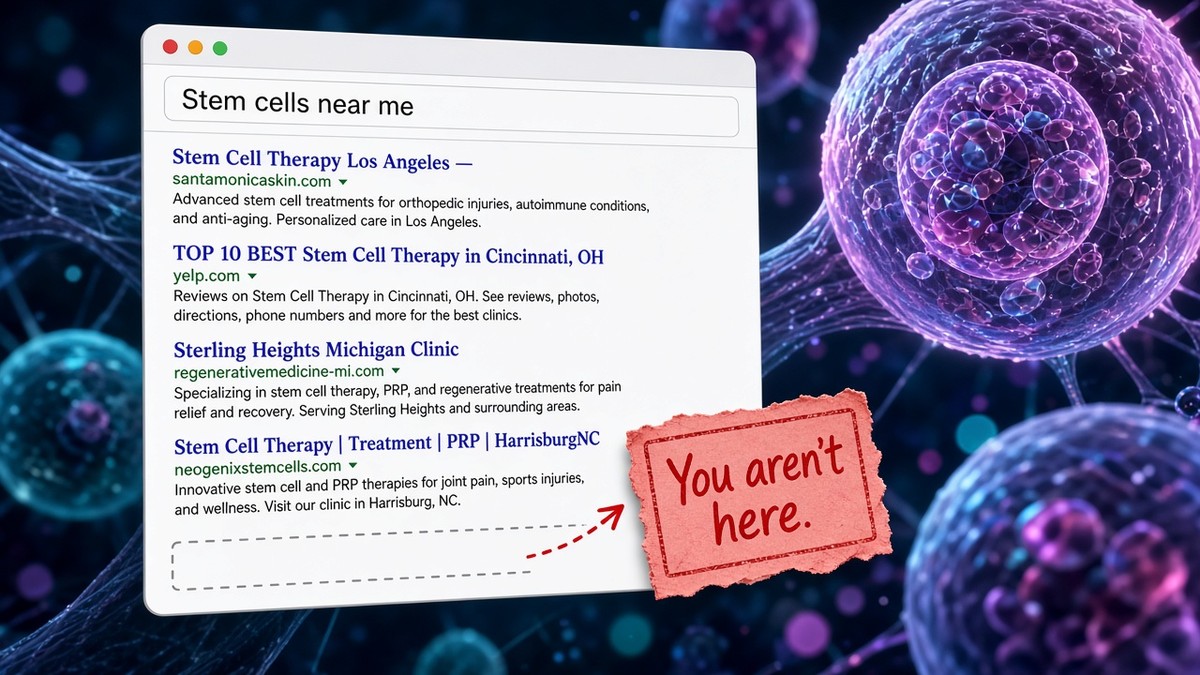
Most practices that start regenerative medicine SEO quit around month four. Nothing has happened yet, the invoices have arrived, and paid ads next door are producing consultations this week. The decision looks obvious at the time and it is usually wrong, because month four is roughly where the work stops being invisible and starts being measurable.
Regenerative medicine SEO generally takes six to twelve months to produce patients. The category is medical, which Google holds to a higher evidence standard. The search volumes are small. It is the cheapest patient channel you will ever have once it lands. It is the wrong place to start if you need cases this quarter.
This piece is about whether the investment makes sense for your practice and what the timeline honestly looks like. For the mechanics of doing the work, see our complete guide to SEO for stem cell clinics. For what we cover when a clinic hires us for it, see our SEO service page.
Why This Is Harder Than Ordinary SEO
Three things make regenerative medicine different from ranking a plumber or a law firm, and all three slow you down.
Google treats health content as a higher-stakes category. Its quality guidelines single out pages that can affect a reader's health or finances, and regenerative medicine is squarely both. In practice that means a thin page written to hit a keyword does not rank, and an unattributed page by nobody in particular struggles against hospital systems and academic centers. Who wrote it, what they practice, and whether the claims are defensible all carry weight here that they do not carry in other categories.
Compliance narrows what you can say. The same claims that get a paid ad rejected will sit on your site indefinitely creating a different kind of risk. You are writing about outcomes you cannot promise, for treatments whose regulatory status varies by indication. That rules out most of the copy a generalist agency would reach for first.
Two different people are searching. A patient types their symptom and their city. A referring orthopedist or chiropractor types the procedure. Those are different pages with different language, and clinics routinely build only the first and wonder why professional referrals never materialize.
The Search Volume Is Small. That Matters Less Than You Think.
The first time a practice owner looks at keyword data for this category, the reaction is usually disappointment. The terms worth having draw hundreds of searches a month, not tens of thousands. Compared with almost any consumer category it looks like a rounding error.
It is not, because the arithmetic is different. A regenerative medicine case is a five-figure, mostly cash-pay decision. A page that quietly produces two patients a quarter is doing more for the practice than a page with fifty times the traffic in a category where the product costs eighty dollars. The question is never how much traffic a term has. It is what one conversion from it is worth, which is why the number to establish before any of this is your patient acquisition cost and what you can afford to pay for a case.
Small volume has a second consequence worth naming: the competition is thinner. Most of these terms are not contested by anyone who has done the work properly. That is the actual opportunity, and it is the reason the timeline is survivable at all.
What the Work Actually Consists Of
In rough order of how often it is the thing that was missing:
Saying plainly what you treat. The most common failure in this category is not technical. It is a site that never states, in the words a patient would use, which conditions it treats and who it treats them for. Nothing can rank you for a category you never claim in writing.
The technical foundation. Crawlability, index coverage, speed, internal linking, URL structure. None of it wins a ranking by itself and all of it can quietly prevent one.
Structured data. Markup for the organization, the services, the location and the questions patients ask. It is how a search engine turns a page into facts rather than prose, and increasingly how an AI assistant decides your page answers the question it was handed.
Pages built on questions patients actually ask, grouped so they reinforce one another instead of competing for the same term. The goal is covering a subject properly, not publishing volume.
Local signals, if you treat patients in person. A claimed and complete business profile, consistent details everywhere they appear, and a steady flow of patient reviews. For a clinic competing in one metro this is often the highest-return work available.
The Timeline, Honestly
Months one to three. Nothing visible happens. Foundation, structure, and the first pages. If you judge the investment here you will cancel it, which is why the cost ceiling and the timeline should be agreed in writing before anyone starts.
Months four to six. Impressions arrive before clicks. You will see terms appearing at positions twenty to forty, which feels like failure and is actually the signal you want — it means the pages are indexed, understood, and competing. First organic inquiries usually show up near the end of this window.
Months seven to twelve. The lower-competition terms reach the first page and the first consultations attributable to organic search appear. This is the earliest point at which judging the channel on revenue is fair.
Year two. The compounding most people were promised in month one. Pages from year one are still producing consultations with little new spend. A term that took until month ten to reach the first page is still sending patients. That is the entire argument for having started.
Anyone promising first-page rankings in ninety days for a medical category is describing a different category, or terms nobody searches.
AI Answers Changed What Ranking Means
A growing share of patients researching a five-figure elective treatment now begin by asking ChatGPT or Perplexity rather than typing into Google. Being the tenth blue link matters less than being the clinic a model names when someone asks who treats this condition in their city.
Most of the underlying work is the same: say clearly what you are, make the facts machine-readable, and cover the subject properly. One part is genuinely different. What ranks you in Google is largely what is on your site; what gets you named by a model is largely what the rest of the web says about you — reviews, directories, third-party mentions. A clinic with a flawless site and no presence anywhere else can be invisible in AI answers while ranking adequately in search. We wrote about how stem cell clinics show up in ChatGPT and AI search separately.
When SEO Is the Wrong First Move
It is the wrong first move if you need cases this quarter. Paid search and paid social buy patients now at a known cost; SEO buys them later at a lower one. That is a sequencing question rather than a choice between them, and we worked through it in stem cell ads vs SEO.
It is also the wrong first move if your intake is broken. Organic leads arrive at the same phones that are already missing calls. More qualified traffic into a funnel that loses people is an expensive way to find out what was wrong.
And it is the wrong move if you cannot fund twelve months of it. Nine months of SEO produces the costs without the asset. Of all the ways to waste money in this category, stopping at month nine is the most complete.
In-House or Hire Someone
In-house works, on one condition: someone has to write consistently for a year. Not a burst of six articles in January. The practices that succeed at this generally have a clinician who genuinely wants to write and protects the time, and that person's pages usually outperform anything an agency would have produced, because the expertise is real and Google is looking for exactly that.
If nobody will do that, hiring is the honest answer, and what you are paying for is narrower than most agencies imply. The fuller list is in what a regenerative medicine marketing agency should actually do. You are paying for someone who already knows where the compliance lines sit rather than learning them on your budget, who has seen the long decision cycle before, and who will not quietly swap your patient outcomes for keyword density.
Worth asking any firm you talk to, including us: show me your own search presence. An SEO agency that does not rank for its own category is asking you to buy something it has not managed to produce for itself.
Frequently Asked Questions
How long does regenerative medicine SEO take to work?
Six to twelve months before organic search produces consultations, with impressions and rankings visible from around month four. Medical categories move slower than most because the evidence standard is higher and the pages competing with you are often hospital systems.
Is the search volume high enough to be worth it?
Yes, when you price it by case value, not traffic. The case value is five figures and the competition is thin. Judge a term by what one conversion is worth, not by its monthly search count. A page producing two patients a quarter in this category pays for itself many times over.
Can I do regenerative medicine SEO myself?
Yes, if you will publish consistently for a year and you understand what you cannot claim. A practicing clinician writing their own pages has an advantage no agency can buy. The failure mode is not quality, it is stopping.
Does SEO still matter if patients are asking ChatGPT?
It matters more, and the work overlaps heavily. Models read the same web. The difference is that AI answers lean harder on what third parties say about you — reviews, directories, mentions — so a clinic with a good site and no external presence can rank adequately and still never get named.
Should I target national or local terms?
Local, if patients travel to you, and both if you draw from outside your region. Local terms convert far better and are far easier to win. National terms are worth pursuing once the local set is handled.
Want to know whether SEO is the right next move for your practice, or whether something else should come first? Book a free strategy call.